
Risk Assessment for Free AI Legal Tools
Table of Contents
- Introduction
- Docassemble: The Genuinely Free Option That Requires Real Skills
- Google Scholar: Legal Research That’s Actually Free
- Free Law Project: Semantic Search and Court Records
- Law Insider: Free Contract Clause Search With Upgrade Path
- ChatGPT and GPT-4: The Most Dangerous Free Legal Tool
- Claude: Anthropic’s Alternative With Similar Limitations
- Casetext CoCounsel: Free Trial That Converts to Paid
- vLex Vincent: Another Trial-Based Approach
- Harvey AI: Enterprise-Only Means Not Actually Free
- Lexis+ AI: Free for Current Subscribers Only
- Westlaw Precision: Similar Subscriber-Only Approach
- Bing Chat Enterprise: Free Microsoft 365 Integration
- When Free Tools Make Sense and When They Don’t
- Security and Confidentiality Considerations for Free Legal Technology
- The True Cost Calculation
- Bottom Line
- Introduction
- Docassemble: The Genuinely Free Option That Requires Real Skills
- Google Scholar: Legal Research That’s Actually Free
- Free Law Project: Semantic Search and Court Records
- Law Insider: Free Contract Clause Search With Upgrade Path
- ChatGPT and GPT-4: The Most Dangerous Free Legal Tool
- Claude: Anthropic’s Alternative With Similar Limitations
- Casetext CoCounsel: Free Trial That Converts to Paid
- vLex Vincent: Another Trial-Based Approach
- Harvey AI: Enterprise-Only Means Not Actually Free
- Lexis+ AI: Free for Current Subscribers Only
- Westlaw Precision: Similar Subscriber-Only Approach
- Bing Chat Enterprise: Free Microsoft 365 Integration
- When Free Tools Make Sense and When They Don’t
- Security and Confidentiality Considerations for Free Legal Technology
- The True Cost Calculation
- Bottom Line
Introduction
Risk Assessment for AI Legal Tools:
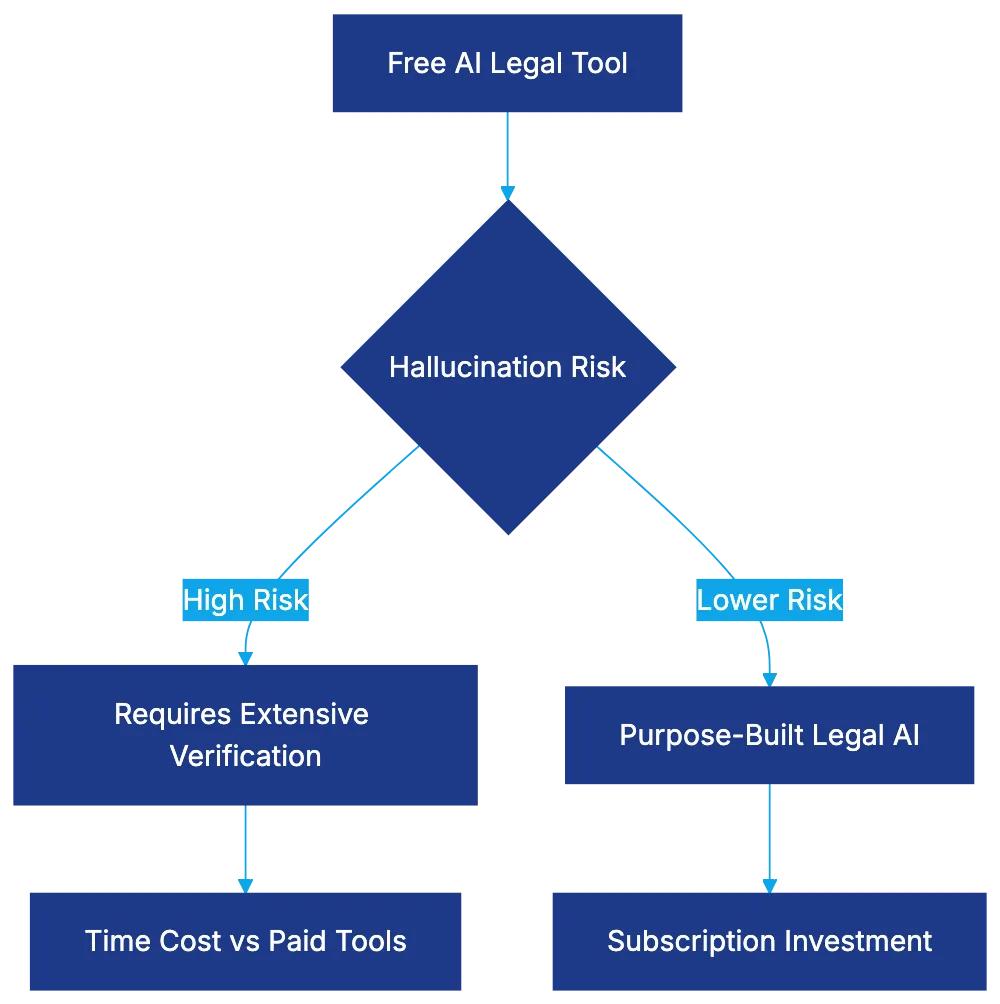
The promise of free AI legal tools sounds appealing for budget-conscious legal practitioners. Yet, research from Stanford HAI indicates that general-purpose AI tools can hallucinate legal queries 49-82% of the time, requiring thorough verification. This guide explores twelve genuinely free AI legal tools in 2026, describing their limitations, paywalls, and hidden costs. Some tools offer significant value, while others might cost more in time than paid subscriptions.
Docassemble: The Genuinely Free Option That Requires Real Skills
Docassemble stands alone as a free, fully functional legal AI tool. It’s open-source document automation software that uses Python and YAML, allowing usage and modification without fees. It generates legal documents and integrates with OpenAI API for AI-assisted drafting. Technical skills are required: understanding Python, writing YAML files, deploying Docker, and server management. A solo practitioner spent forty hours learning Docassemble to produce documents without monthly fees.
Hidden costs include hosting and maintenance, with servers costing $15-$100 monthly, depending on volume and security needs. For high document production, costs are justifiable.
Google Scholar: Legal Research That’s Actually Free
Google Scholar offers free legal research with federal and state court decisions and basic citation analysis. Limitations exist without advanced search or editorial enhancements found in Westlaw. It’s ideal for small matters or initial research. One legal aid attorney begins research on Google Scholar, using Westlaw for verifying complex cases.
Free Law Project: Semantic Search and Court Records
Free Law Project launched semantic search in March 2025 within CourtListener, enabling case searches by meaning rather than keywords. It includes millions of court records. While a nonprofit budget limits user interface polish, the combined semantic search and RECAP archive of PACER documents offer true cost savings for federal litigation. However, time and verification are required due to less intelligent ranking.
Law Insider: Free Contract Clause Search With Upgrade Path
Law Insider allows free access to contract clauses from SEC filings. It’s valuable for drafting commercial agreements but caps document views and search features without a subscription. This freemium design allows occasional free use, with paid options available for regular drafting and clause library building.
ChatGPT and GPT-4: The Most Dangerous Free Legal Tool
ChatGPT remains free with GPT-4, popular yet risky with hallucination rates of 49-82%. The limitations include peak-time restrictions and lack of privacy. It’s useful for drafting communications or brainstorming but requires extensive verification. An attorney utilizes ChatGPT for drafting demand letters but spends time verifying outputs.
Claude: Anthropic’s Alternative With Similar Limitations
Claude, by Anthropic, similarly offers a free tier with built-in reluctance for definitive legal claims. Useful for document analysis, Claude supports lengthy document processing, offering a cautious approach but with required output verification.
Casetext CoCounsel: Free Trial That Converts to Paid
Casetext offers a free trial of CoCounsel, a legal AI on GPT-4, trained to reduce hallucinations. Strategy during the trial can determine efficiency benefits worth the subscription cost of several hundred dollars monthly.
vLex Vincent: Another Trial-Based Approach
Vincent from vLex offers a free trial for AI-assisted legal research, valuable with aligned practice areas and vLex’s database. The emphasis rests on time management during the trial to evaluate workflow benefits.
Harvey AI: Enterprise-Only Means Not Actually Free
Harvey AI isn’t free for individuals but available in large firms covering the cost. It underscores the difference between institution-access tools and individually accessible options.
Lexis+ AI: Free for Current Subscribers Only
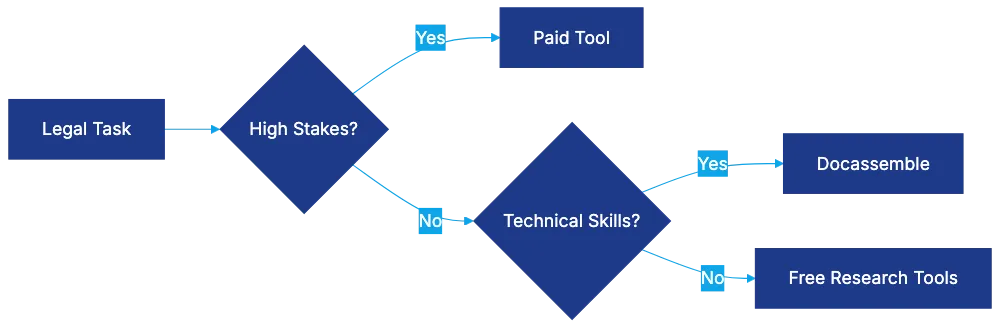
Decision Framework for Free vs Paid Legal Tools:
Lexis+ enhances current subscriptions with AI features at no cost to existing users, integrating AI summarization and research support.
Westlaw Precision: Similar Subscriber-Only Approach
Westlaw Precision offers AI-assisted features integrated into subscriptions. Users assess efficiency versus cost when considering continued subscription use.
Bing Chat Enterprise: Free Microsoft 365 Integration
Bing Chat Enterprise offers AI access with Microsoft 365 business subscriptions, providing data protection. It’s beneficial for firms already paying for Microsoft 365 but not suitable for confidential legal work due to hallucination risks.
When Free Tools Make Sense and When They Don’t
True Cost Components of Free Legal AI:
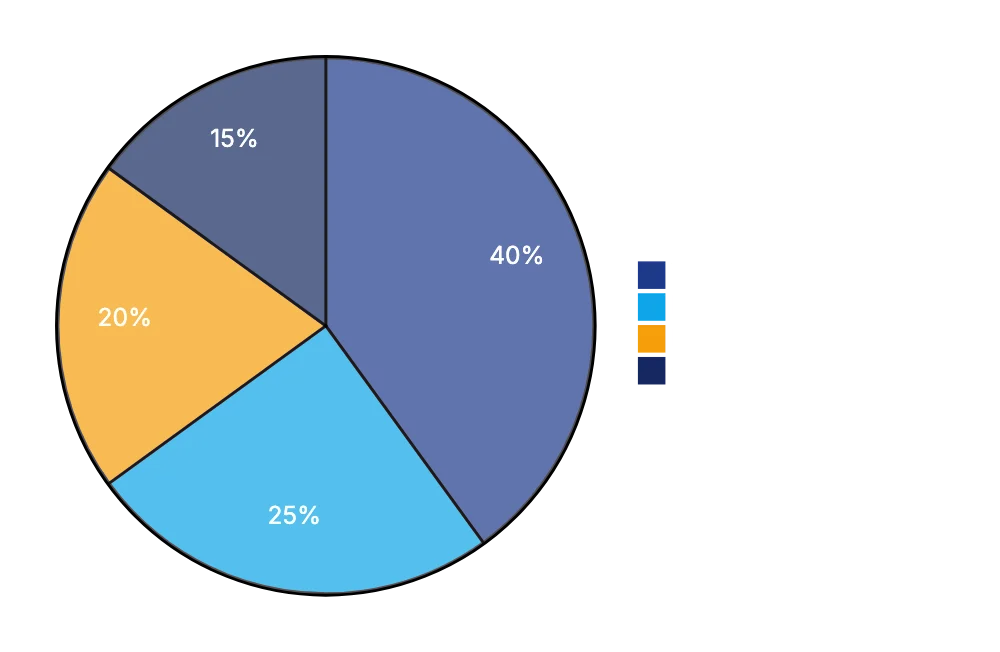 Choose free tools for occasional work, technical skills, preliminary research, or non-legal work. Avoid them for high-stakes work, regular database needs, or sensitive tasks requiring confidentiality. The cost calculation should consider hourly rates and the time spent verifying flawed outputs. Use paid tools for high-volume, high-risk, or client-confidential tasks.
Security and Confidentiality Considerations for Free Legal Technology
The main hidden cost of free AI legal tools is potential confidentiality breaches. Avoid using consumer AI platforms for client information without contractual data protections. Paid tiers offer these protections, and bar associations emphasize ongoing attorney responsibility.
The True Cost Calculation
Calculating true costs involves time, risk, and opportunity costs, not just subscription fees. Training, verification, and output risks might exceed the cost of purpose-built legal tools. Consider effective hourly rates when choosing between free and paid options.
Bottom Line
Free AI legal tools offer some value but often involve hidden costs requiring thorough verification, especially with general-purpose AI like ChatGPT. Docassemble provides truly free document automation for tech-savvy users. Google Scholar and Free Law Project complement paid research tools, while ChatGPT needs careful verification. Use free tools for preliminary tasks and learning, saving paid tools for detailed, confidential work. Attorney judgment, verification, and responsibility remain paramount.
Frequently asked questions
What is the main limitation of using free AI legal tools?
The primary limitation is the high rate of errors or “hallucination” in outputs, which can range from 49-82%. This necessitates rigorous verification by the user, making the tools time-consuming to rely upon for critical legal work.
Are there any free AI legal tools that require technical skills?
Yes, Docassemble is a fully free legal AI tool that necessitates technical skills such as knowledge of Python and server management. Users must be comfortable setting up their own hosting solutions, which implies additional hidden costs for infrastructure.
How can I access legal research for free?
Google Scholar and Free Law Project are excellent options for conducting free legal research. Google Scholar offers access to court decisions, and Free Law Project provides semantic search capabilities for deeper insights into case law.
Is ChatGPT safe to use for legal drafting?
While ChatGPT can be helpful for drafting documents, its high hallucination rate means outputs should be carefully verified. Users should rely on such tools for preliminary drafting or brainstorming while ensuring final outputs are double-checked for accuracy.
When should I consider using paid legal tools instead of free ones?
Paid legal tools are advisable for high-stakes cases, regular access to databases, and tasks requiring confidentiality. The cost of time spent verifying free tool outputs can often exceed the subscription fees of professional legal services.
What are the hidden costs associated with free AI legal tools?
Hidden costs can include time spent on verification, potential security breaches, and the need for technical skills to fully utilize certain tools. Additionally, ongoing training and maintenance can add to the overall expense of using apparently free options.
How can I ensure confidentiality when using free AI legal tools?
To maintain confidentiality, avoid using consumer AI platforms for sensitive client information unless they offer specific data protections. It is crucial to adhere to the ethical standards set by bar associations concerning client confidentiality and information security.